

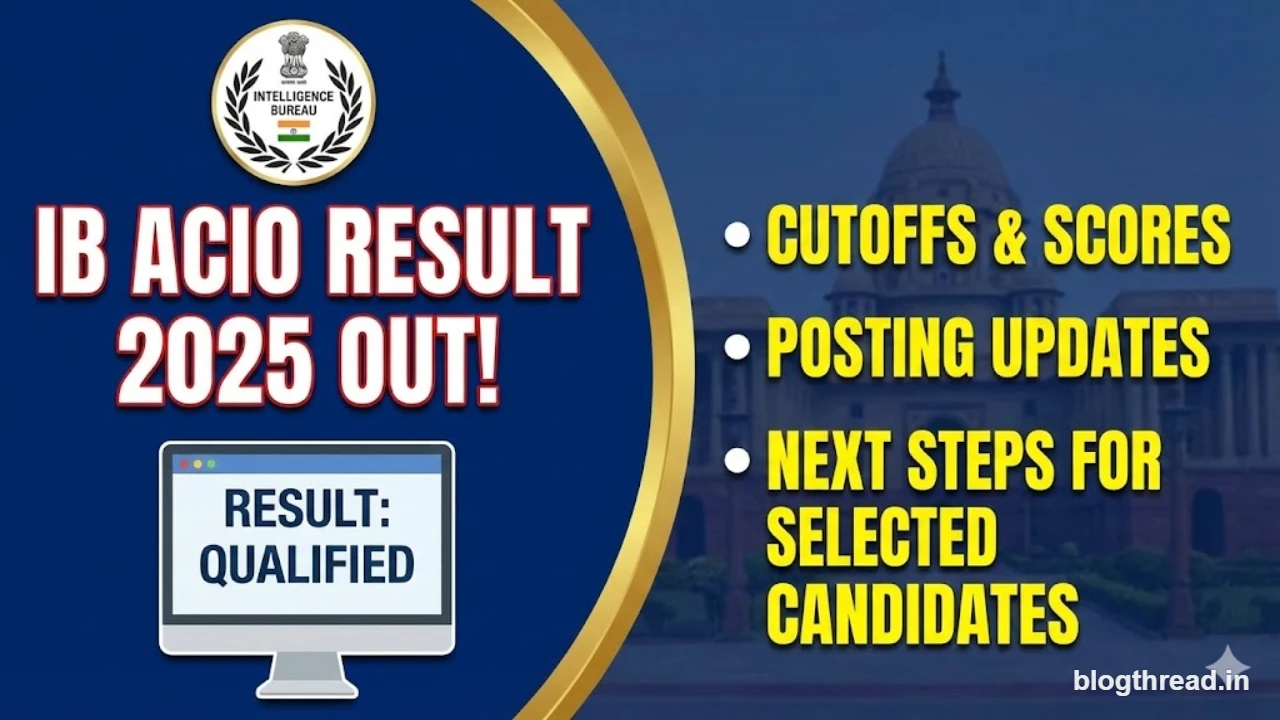
IB ACIO Result 2025: what’s official now
The Intelligence Bureau (MHA) has released the ACIO Grade‑II/Executive Tier‑1 result in PDF format with roll numbers of shortlisted candidates, and the scorecard window is opening in phases. The notification confirms that Tier‑2 (descriptive) is the next stage, followed by interview and medical/document checks. If your roll number appears in the merit list, treat the next 4–6 weeks as a focused sprint for descriptive writing and dossier readiness.
Cut-off picture: what to expect this cycle
Category‑wise official cut-offs will be published with or shortly after scorecards; till then, most expert trackers are converging in the same band. For Tier‑1 out of 100, safe ranges are hovering around UR 70–78, OBC 70–76, EWS 64–70, SC 62–66, and ST 63–65, with minor zone‑to‑zone variation due to normalisation and shift difficulty. Use these as directional markers only—final allocation depends on performance across Tier‑1 + Tier‑2 + interview and your category merit.
| Category | Safe Range (Tier‑1/100) |
|---|---|
| UR | 70–78 |
| OBC | 70–76 |
| EWS | 64–70 |
| SC | 62–66 |
| ST | 63–65 |
Tier‑2 (descriptive): scoring plan in 21 days
Tier‑2 tests crisp, structured writing under time pressure. Build a 3‑week plan around daily editorials, 2 essays per week, and alternate‑day precis/letter practice. Focus themes that IB cares about: internal security, border management, cyber threats, economic intelligence, social media misinformation, federalism, data privacy, and neighbourhood geopolitics.
- Essay (800–1000 words): thesis‑driven, 3–4 arguments, counter‑view, actionable conclusion.
- Precis: 1/3rd length, preserve tone, include key data points, avoid new ideas.
- Letter/Report: official format, subject line, clear asks, concise annex cues.
| Practice Slot | Task & Target |
|---|---|
| Mon/Wed/Fri | One essay; 40–45 mins; peer/self review checklist |
| Tue/Thu | Precis + Letter/Report; 30 mins each |
| Sat | Full Tier‑2 mock (90 mins) under exam conditions |
| Sun | Error log consolidation + model answers |
Interview readiness: narrative, not memorisation
Post Tier‑2, interview panels probe clarity of thought, ethics, and situational judgment. Prepare a personal narrative linking your background to public service and national security, and rehearse structured responses using the situation–action–impact frame. Expect questions on current affairs, your home state, and sensitive workplace scenarios where discretion and chain‑of‑command matter.
- File a 60‑second intro covering education, key skills, and motivation to join IB.
- Prepare 6–8 crisp briefs on security topics (Naxalism, border infiltration, cyber fraud, OSINT, radicalisation).
- Mock interviews: 2–3 rounds with feedback on tone, brevity, and composure.
Documents and medical: no last‑minute surprises
Start assembling your dossier now to avoid DV delays. Use government‑prescribed formats for category/EWS/ESM/PwBD, ensure name/date consistency across IDs, and keep photocopies ready. For medicals, basic fitness, vision (with/without correction as per standard), and absence of disqualifying conditions are key—carry your latest prescription if you use spectacles.
- Identity & age: Aadhaar, PAN, 10th certificate for DOB.
- Education: degree/mark sheets; equivalence letters if applicable.
- Category/EWS: latest format, valid dates, authority seal.
- Character/antecedents: be transparent; adverse findings can void selection.
Vacancies, merit and normalisation: how final selection works
Recruitment this year is for several thousand ACIO‑II/Exe posts with district/branch distribution done centrally. Shortlisting uses normalised Tier‑1 scores; final merit weights Tier‑1, Tier‑2 and interview as per notified scheme, and tie‑breaking typically prefers higher Tier‑2/older age depending on rules. Your posting is service‑exigency based; preferences are noted but operational needs prevail.
Posting and training: what to expect
After final merit and verification, candidates receive provisional offers with joining instructions. Basic training covers legal framework, tradecraft basics, reporting protocols, and field sensitisation; subsequent posting can be anywhere in India across metro, border, and sensitive units. Early career roles are mix of desk analysis and field coordination—versatility and confidentiality define growth.
If your name isn’t in the PDF
Don’t disengage yet—wait for scorecards and official cut‑offs to gauge the gap. If you’re within 5–8 marks of the projected band, build a fast‑track plan for the next notification; preserve your current prep momentum. Audit mocks, strengthen GK with daily briefs, and refine writing—these carry forward directly to the next cycle.
Action checklist for the next 72 hours
- Download the result PDF and save it in multiple drives.
- Set up a 21‑day Tier‑2 schedule; block daily 90 minutes for writing.
- Assemble DV file with originals + 5 self‑attested copies.
- Book two mock interviews; prepare state and district briefs.
- Sleep, hydration, and light exercise—stamina is a competitive advantage.
Bottom line
The result PDF is only halftime—the decisive innings is Tier‑2 and interview. Keep your writing sharp, your documents watertight, and your head cool. With disciplined execution over the next month, a roll number in the PDF can become a joining letter.


0 Comments
No comments yet. Be the first to share your thoughts!